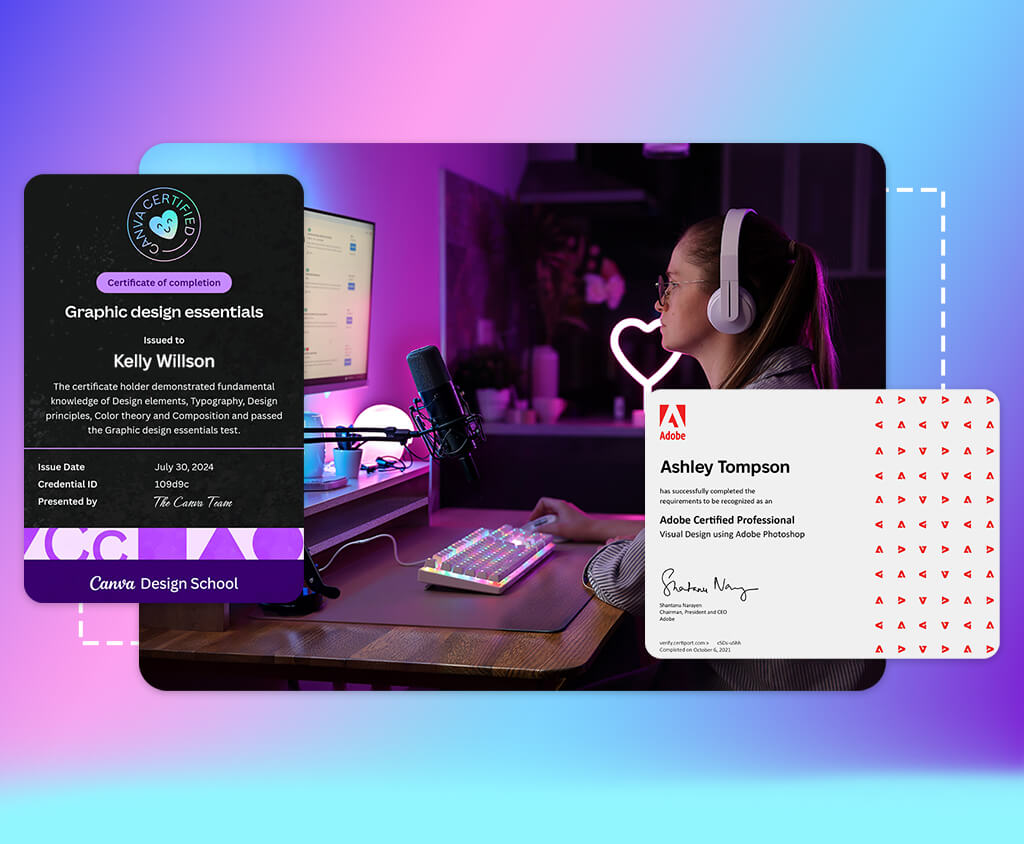
In the past, it was almost impossible to become a graphic designer without getting a university degree first. However, nowadays, design trends, AI, and software change so rapidly that graphic design certifications have begun to serve as a clear sign that your skillset is up-to-date and you have the expertise necessary for specific jobs.
I’m of two minds regarding such certifications since their reputation is inconsistent, and a lot of them prioritize software workflows over sharp design thinking. When I began looking into them, I was disappointed to see that many certifications look “official” but don’t bring any actual value.
I started researching real graphic design certifications online while accounting for my own professional experience. My coworkers helped me by providing feedback and their own personal insights. I tested 20+ platforms to figure out what they offer, how they evaluate skills, and whether they provide any actual value.
When picking the best graphic design certifications, I prioritized several factors: how practical the studies are and whether it allows for the development of actual design skills instead of focusing solely on theory. Additionally, I checked if the program offered a recognized certificate that could be added to my resume or LinkedIn.
When I first began checking out various design certification programs, I made quite a few mistakes while also witnessing how many others lose time by picking the wrong approach.
LinkedIn’s Workplace Learning Report makes it clear that skill development and certifications are among the fastest-growing priorities for professionals around the globe in 2025-2026, as businesses put a premium on demonstrable skills over traditional college degrees.
However, just earning a bunch of certificates isn’t enough, as you need to continuously develop practical skills, put them to real-world application, and tackle real projects to showcase what you can do.
My view on this matter changed entirely once I stopped looking at certifications as the end goal and began treating them as a structured guide for practice.
Typical price: about $100-$180 per exam
Time to complete: around 50-90 minutes for the exam + 2-4 weeks of preparation
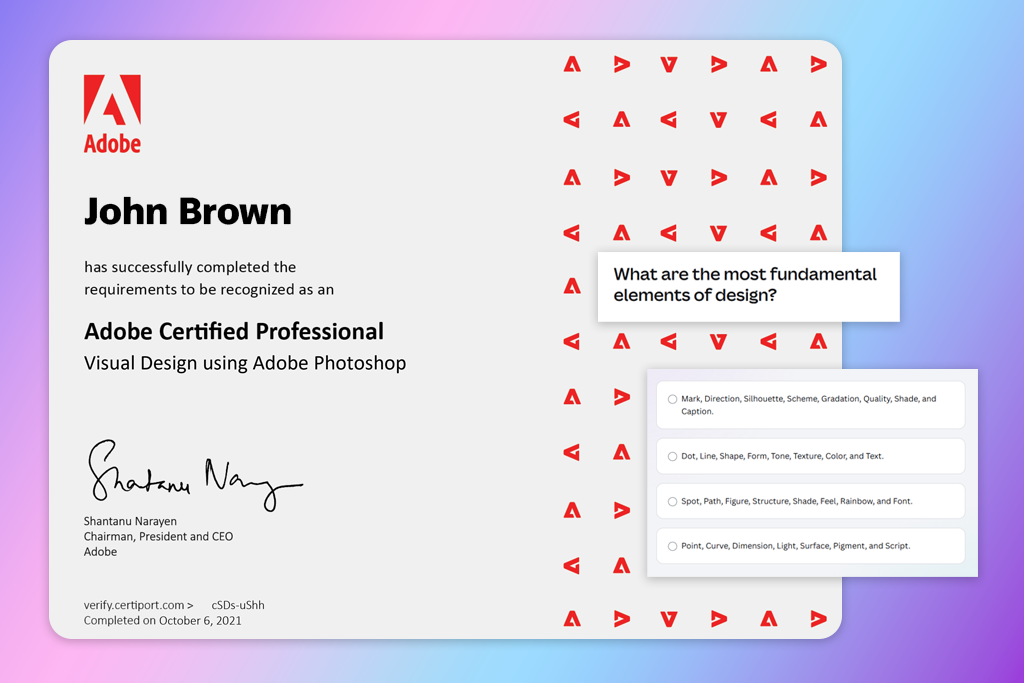
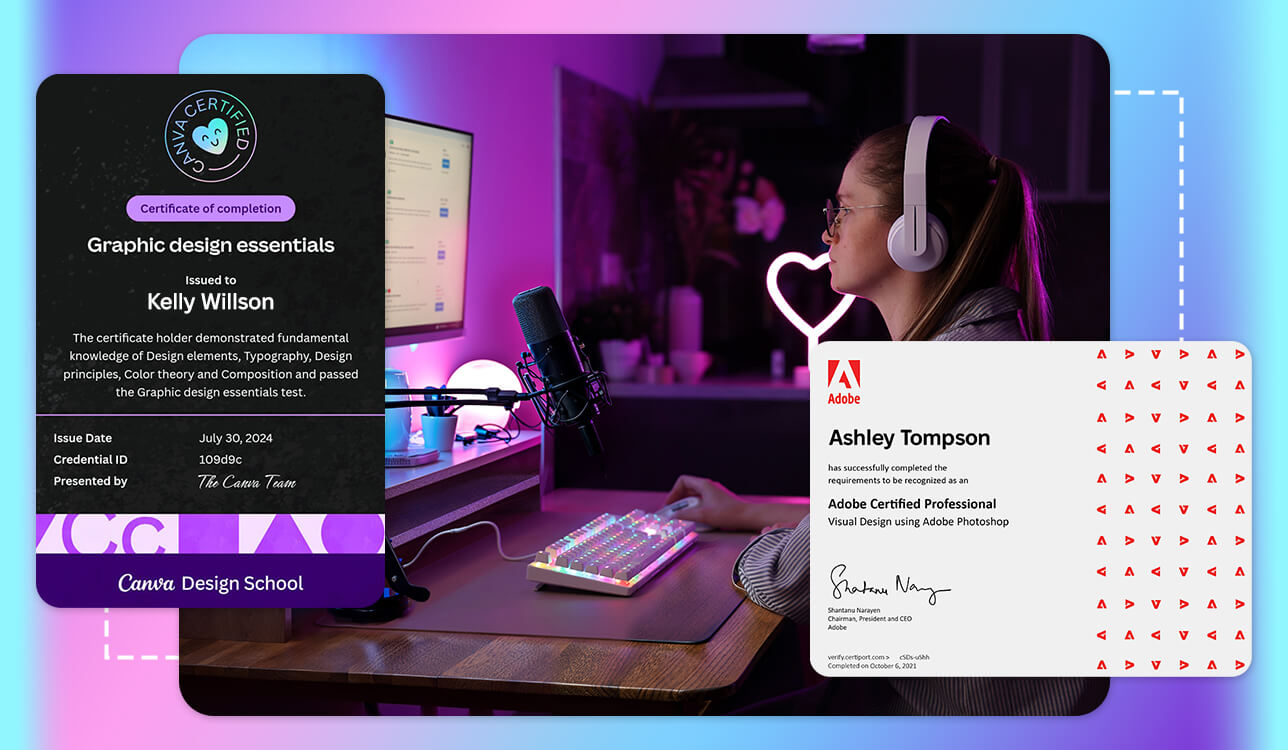
The Adobe Certified Professional (ACP) is among the most reputable graphic design professional certifications you can get for proving your mastery of Adobe software like Photoshop, Illustrator, or InDesign.
It prioritizes the development of practical design skills and real-world workflow execution instead of theoretical lessons, which is why it’s so important for beginners and experts who want to get Adobe certified and showcase their expertise with industry-leading solutions.
Even though graphic design remains a primarily portfolio-based industry, this certification adds actual value by serving as concrete proof that you are competent at handling industry-standard software. It allowed me to deepen my understanding of structured workflows, time-sensitive tasks, and precision-focused projects, not just creativity.
The exam is entirely performance-based and done using Adobe applications. I completed timed tasks that included remaking layouts, tweaking elements, and structuring assets while adhering to strict instructions, which heavily resembled actual studio work.
I also liked the inclusion of the Specialty Credential: if you get two eligible Adobe Certified Professional certifications (for instance, Photoshop and Illustrator), you automatically earn an extra badge signifying your broader skills across Adobe software. When preparing, I practiced daily in free Adobe software, focused on official exam objectives, and completed timed exercises to emulate the actual test environment.
Other than ACP, Adobe also provides higher-level certifications like Adobe Certified Expert (recommended experience: 1 to 3 years) and Adobe Certified Master (recommended experience: 3 to 5 years), which are aimed at more experienced graphic designers.
Where to take the exam: Certiport or via PSI Exams Online
“I greatly value this certification since it serves as proof of real workflow abilities rather than general theoretical knowledge.”

Typical price: about $39-$60 per month on Coursera (subscription-based)
Time to complete: about 4-6 months with part-time study
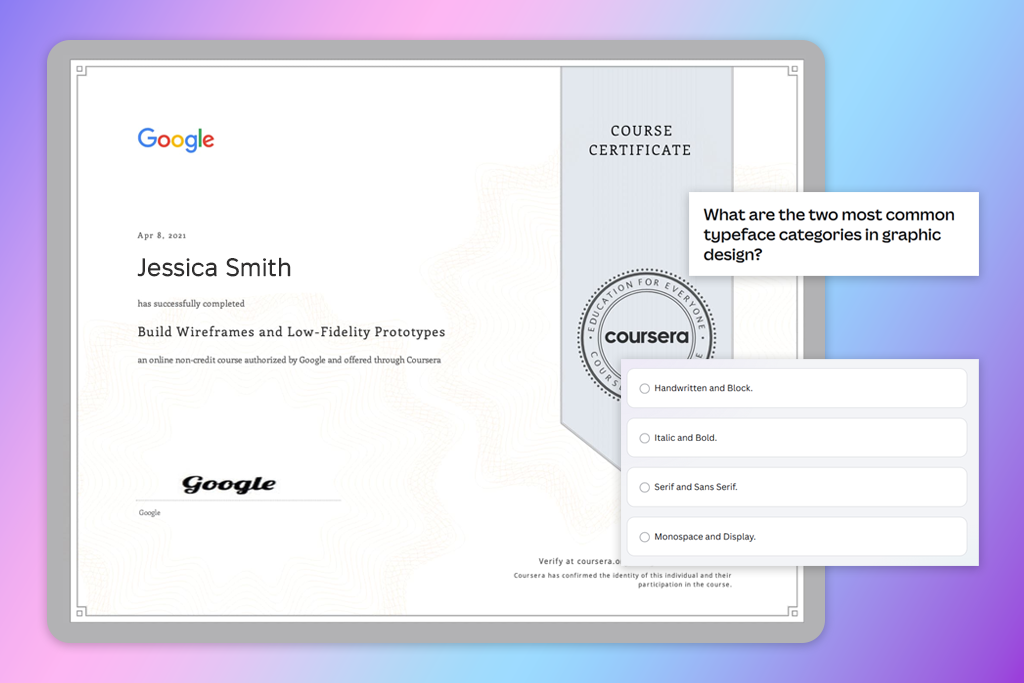
Google UX Design Professional Certificate is known for being easily accessible and beginner-oriented. This graphic design certificate program prioritizes UX fundamentals, research, and software like Figma. It can be completed entirely online via Coursera and is aimed at self-paced learning.
It goes over user research, wireframing, prototyping, usability testing, and basic interaction design. I appreciated the structure and organization of this program, but it felt more educational than related to actual industry workflows, meaning you need to put in additional portfolio work to complement this certificate.
You don’t have to pass a traditional exam here. Instead, you’ll have to complete quizzes, assignments, and project-based case studies. I handled step-by-step UX projects that allowed me to figure out the design philosophy, but I still had to create extra real-world projects outside the program to boost my portfolio.
Google certificates are gaining more and more recognition by recruiters and commonly serve as a key to entry-level positions in tech and digital agencies.
Ordinarily, you aren’t required to have any experience to participate in this course. However, for preparation, I recommend sticking to the recommended order of the modules offered in Figma while also completing repeated assignments to polish your workflow.
The offered flexibility was greatly appreciated since I could combine this program with other projects and learn at my own pace. This course also offers modules focused on resume creation, mock interviews, and portfolio presentation.
Where to take the exam: Coursera
Typical price: about $39-$60/month on Coursera (subscription-based)
Time to complete: around 4-6 months with part-time study
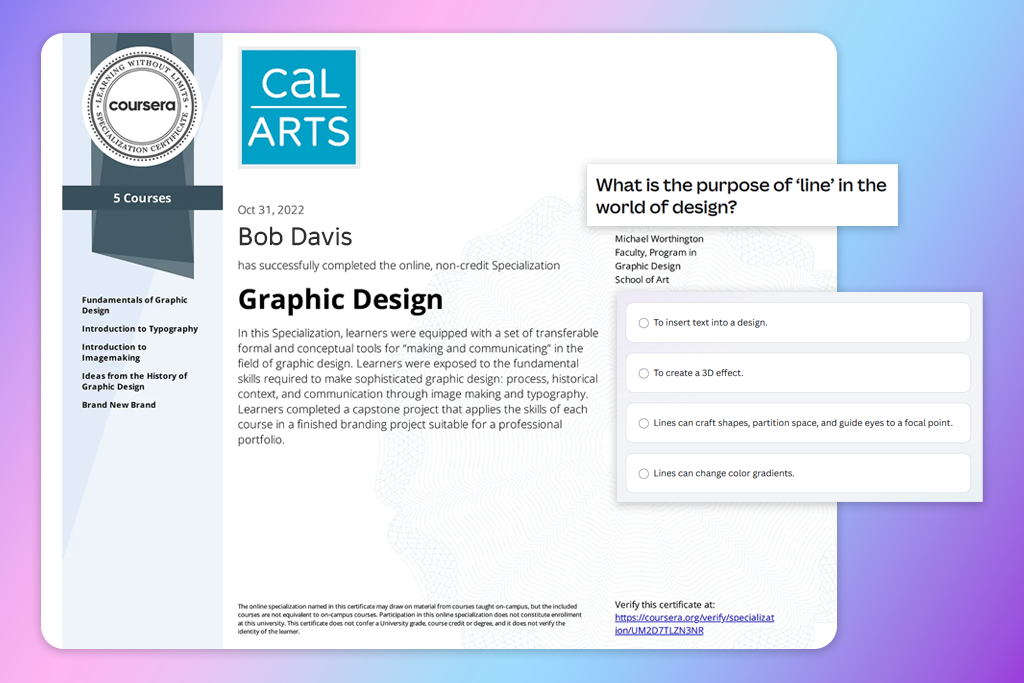
Once I chose to reinforce my fundamentals via graphic design courses backed by certifications, I went with the CalArts Graphic Design Specialization on Coursera. It offers a mix of courses + certification, and the certificate you get after finishing it can be included in your resume or added to your LinkedIn page.
In my opinion, it’s among the best-organized academic-style graphic design certifications for beginners available online. The fact that this certificate is provided by CalArts makes it feel more credible when looking for entry-level positions or putting together a design portfolio. It proves you’ve finished an entire learning path, which can be essential when breaking into a new industry.
This course is held entirely online and is focused on projects rather than traditional exams. Instead of testing software skills, this free online graphic design course prioritizes conceptual thinking and design theory. It also doesn’t adhere to rigid examination formats. The assessment is conducted based on peer-reviewed projects, quizzes, and final assignments.
While this certificate can be a great boon for beginners, it can’t replace actual industry experience. Peer feedback can lack consistency, and the absence of in-depth software training means you need to learn software like Photoshop and Illustrator on your own to put your knowledge to the test.
Where to take the exam: Coursera
“CalArts provides a firm foundation, but it’s more educational than practical when it comes to actual client scenarios.”

Typical price: Free (requires a Canva account)
Time to complete: 45-60 minutes
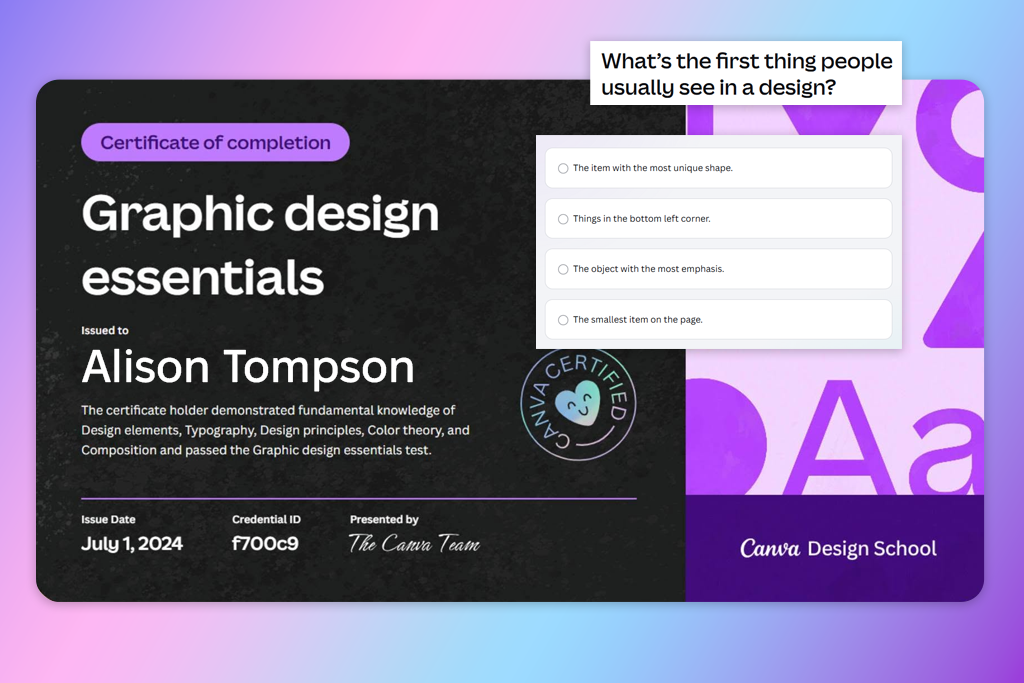
Canva Graphic Design Certification provides a free, newbie-oriented path to learn design basics via Canva Design School. I believe it provides one of the simplest ways to earn a graphic design certificate online, allowing you to get a quick start without mastering complex software or spending dozens of hours learning complex technical terms.
This program focuses on essential design principles like typography, color theory, and layout, while also covering practical applications across various formats. The certification goes over a wide range of project types, including social media graphics, YouTube thumbnails, presentations, PDFs, and print-ready designs.
I appreciated this option since it showcases how graphic design is used across actual projects, not just theory. The process is straightforward: I explored the Canva Design School, picked a course with a “Get certified” option, did all the lessons, completed a brief online test, and added the certificate to LinkedIn while also posting it on my socials.
Canva is a lot closer to a knowledge check than a professional-grade assessment, which is why it’s so great for beginners but lacks depth compared to more advanced graphic design certification programs.
Where to take the exam: Canva Design School
Typical price: Varies based on the program format and membership requirements, from $579
Time to complete: a few weeks to multiple months, depending on portfolio readiness
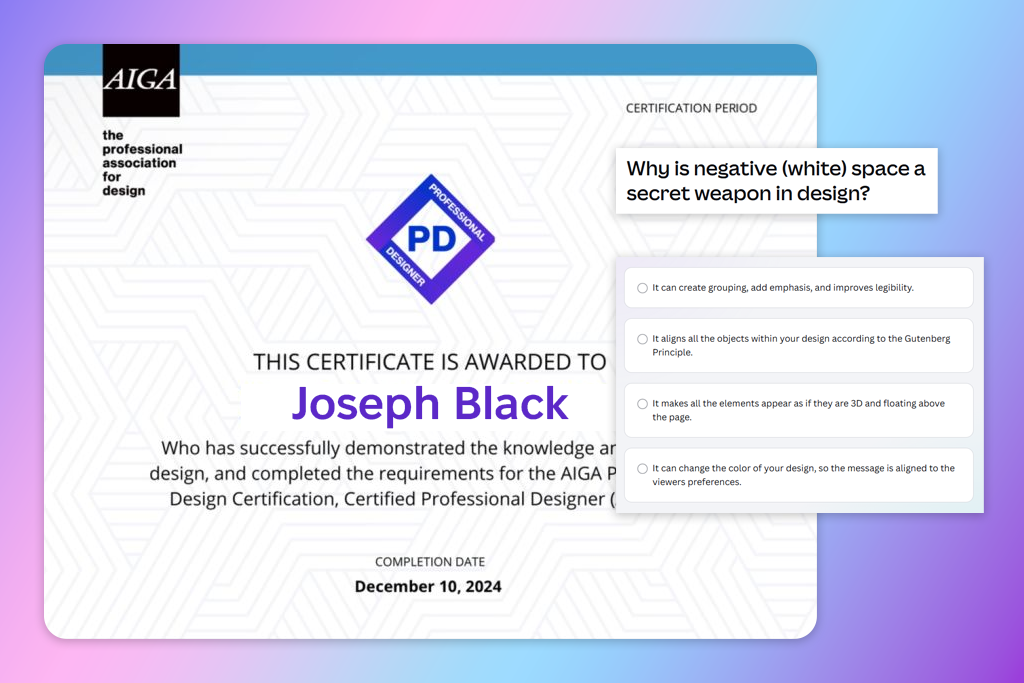
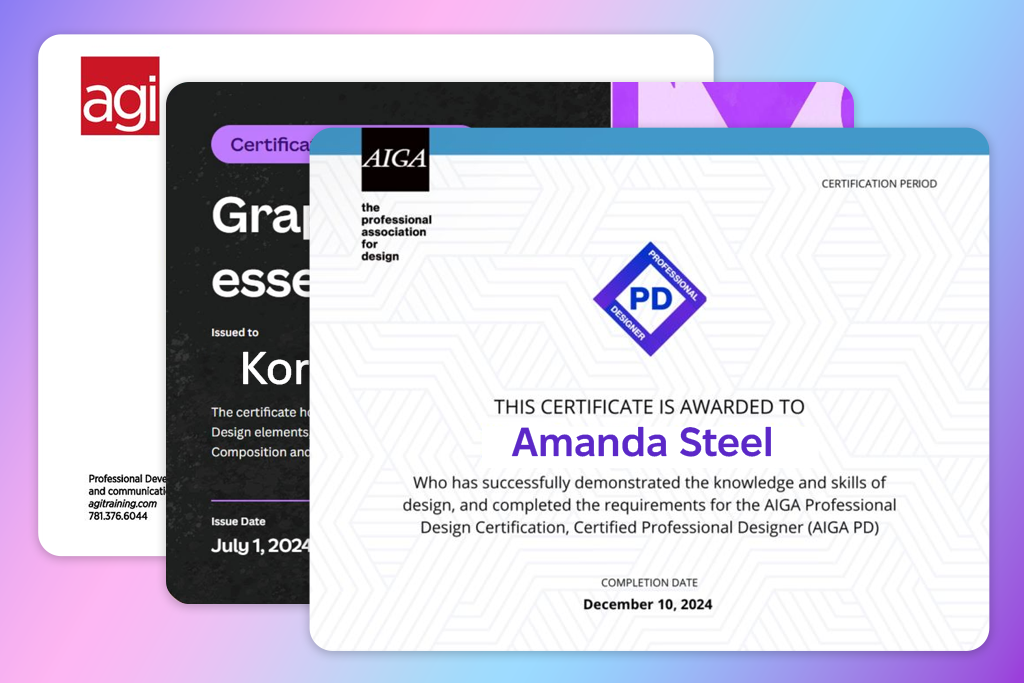
AIGA Professional Design Certification is a professional credential that is meant to verify design knowledge, industry standards, and leading practices instead of narrow application-specific skill sets. This graphic design certification course provides two levels.
The AIGA Professional Designer credential was created for designers who have at least one year of experience, while the AIGA Design Leader certification is targeted at more experienced experts and managers. This is why the certification can remain relevant during multiple career stages.
I appreciated the demonstrated focus on professional growth, creative thinking, communication, branding, and ethical design practices. Additionally, the program goes over relevant topics like accessibility, intellectual property, and inclusive business practices, which tend to be ignored in alternative certifications.
Rather than going all-in on traditional examinations, this certification offers a portfolio assessment where your best professional projects are reviewed. I greatly appreciate such an approach since it focuses on real-world capabilities rather than less useful test-taking skills.
Where to take the exam: Online via the AIGA platform
“From a mentor’s point of view, it’s highly reputable, but it’s aimed at mid-level designers rather than juniors.”

Typical price: $3,600 for the 112-hour Graphic Design Certificate
Time to complete: 112 hours (weeks to months)
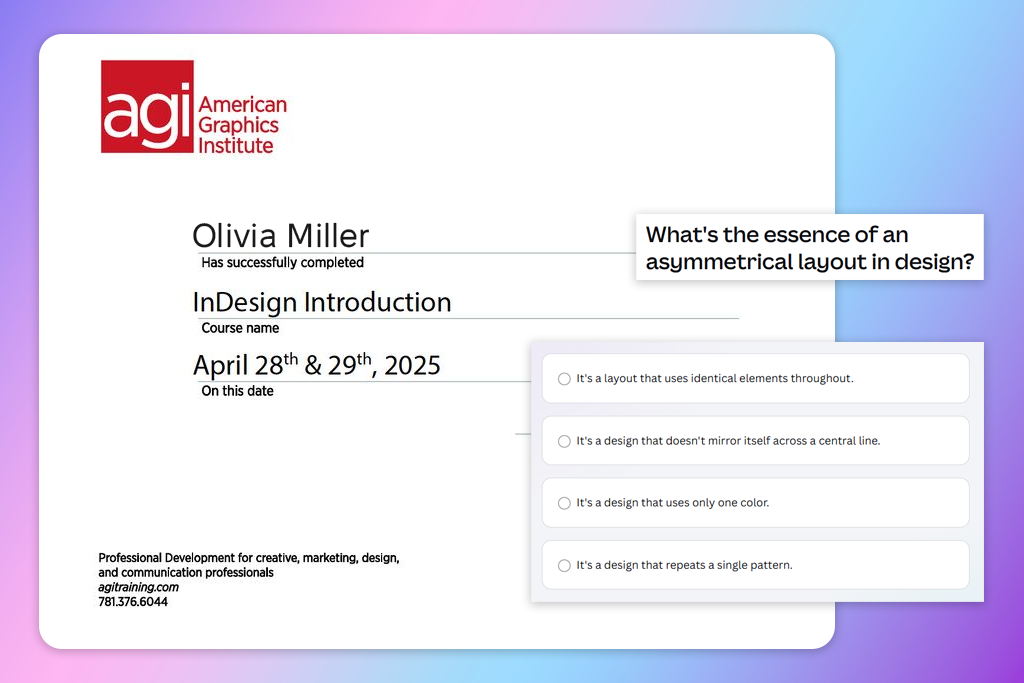
AGI is a licensed training provider that lets you sign up for professional graphic design certification classes that prioritize practical, career-oriented skills. It has programs related to Graphic Design, UX, and Photoshop. I appreciated that the classes are instructor-led and focus on real-world tasks, which makes them more relevant for actual design work.
The issued certificate is respected by big businesses like Google, Apple, Nike, and Amazon, which makes it a lot more credible. The programs are highly adaptable and can be taken online or in person.
Rather than conducting a single examination, learning is based on projects, assignments, and practical tasks. I think such an approach is a lot more beneficial since it prioritizes applying your skills instead of simply passing a test.
Where to take the exam: Offered online or at AGI training centers via American Graphics Institute
Typical price: around $1,995
Time to complete: 3 months (about 40-65 hours of instruction)
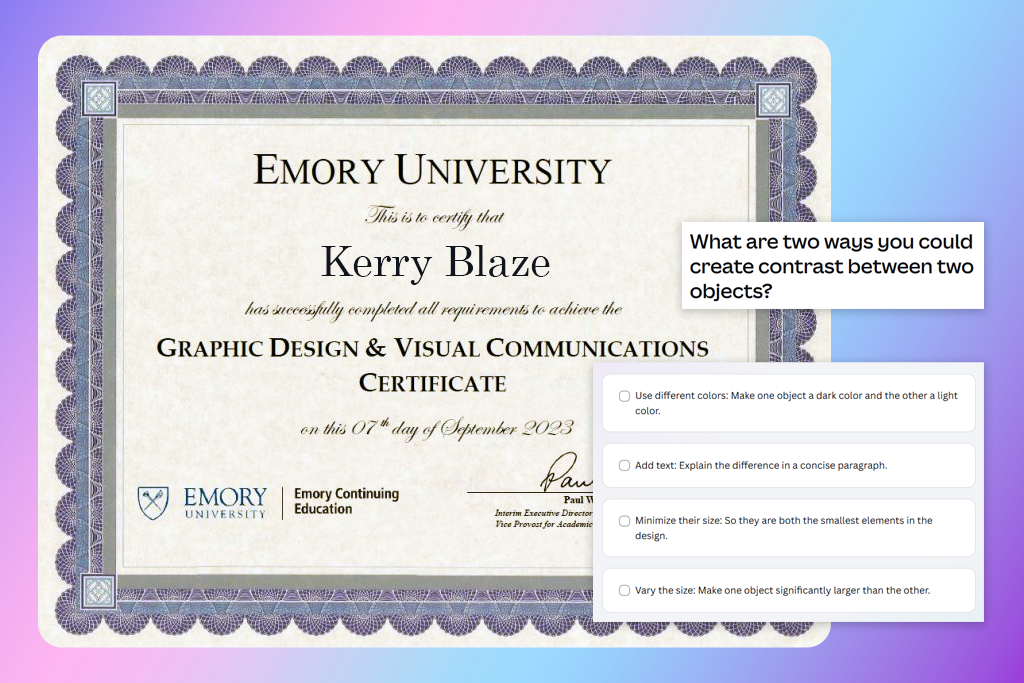
When searching for more structured graphic design training certification for beginners, I managed to find the Graphic Design and Visual Communications Certificate from Emory University. It provides a more academic and disciplined approach compared to the usual online programs, putting an emphasis on organized learning and live lessons.
The course is dedicated to essential aspects like visual communication, layout, typography, and fundamental principles and elements of design. In addition to teaching theory, this course also helps you prepare a portfolio that can help you get entry-level design positions.
The program is done entirely online but includes live classes, which help imitate the setting of an actual classroom. Participants are required to attend at least 80% of sessions and finish all tasks with a minimum score of 75%. Once finished, students get an official certificate and digital badge that can be included in their portfolio or LinkedIn page.
Where to take the exam: Entirely online via Emory Continuing Education
“I love the structure of this certificate, but the live class requirement can be a deal-breaker if you’re looking for a more flexible option.”
They are usually structured programs that prove your graphic design skills across various areas like typography, layout, branding, and software like Adobe Photoshop or Illustrator. They are often presented alongside a portfolio to showcase verified skills to recruiters.
No. There are a lot of graphic designers who get jobs without formal certifications. Your portfolio is the most important part of your job application. Certifications simply help prove your skills.
Some can be done within an hour (like Adobe Certified Professional or Canva Graphic Design Certification, while others require multiple months, such as university or specialization programs.
No. A certification on its own is usually insufficient. For most applications, you’ll have to provide a strong portfolio that features the design projects you’ve completed in the past.
A course focuses on learning skills, while a certification validates the fact that you’ve passed training and met specific requirements. Certifications are more organized and typically include assessments or projects.
Only if they offer actual value. I believe that the wiser approach is to build an impressive portfolio rather than gather a wide range of free graphic design certificates that don’t show actual skill improvement.
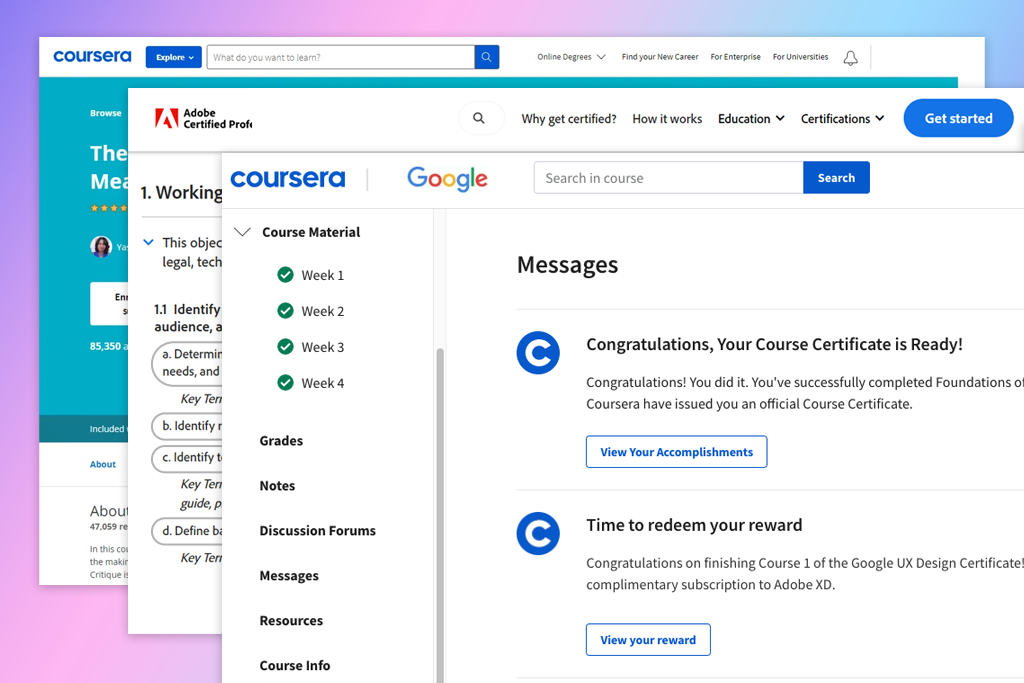
When trying to find the best graphic design certifications, we went through a wide range of options, covering everything from beginner-oriented online certificates to more advanced professional credentials.
During our test, we examined multiple popular programs that failed to make our list, including the certifications offered by the Pratt Institute, Sessions College, Rhode Island School of Design, and Lenoir Community College, since they either prioritized general course completion over structured certification or were represented purely by academic programs with lengthier degree-style pathways.
My team from FixThePhoto assisted me during the test by providing feedback, talking about their personal learning experiences, and trying out various graphic design courses with certificates in parallel. This allowed me to give each option a more objective rating from both a beginner’s and an experienced designer’s perspective.
Our testing process included the following:
The usefulness and value of each graphic design certification largely depend on the specific program in question. Some are perfect for beginners and fast skill validation, while others offer more reputable credentials but require a bigger time investment and an advanced skillset.
The final choice should be determined by your needs, whether you need a quick introduction to the graphic design industry or a certificate that facilitates long-term career growth.





![11 Best AI Virtual Assistants in {{%year}} [Reviewed & Ranked]](http://fixthephoto.com/blog/images/gallery/news_main__preview_29081.jpg)
![9 Best 2x2 Picture Makers [{{%year}} FixThePhoto Choice]](http://fixthephoto.com/blog/images/gallery/news_main__preview_29017.jpg)

![7 Best TIFF to PDF Converters [{{%year}} FixThePhoto Choice]](http://fixthephoto.com/blog/images/gallery/news_main__preview_29305.jpg)